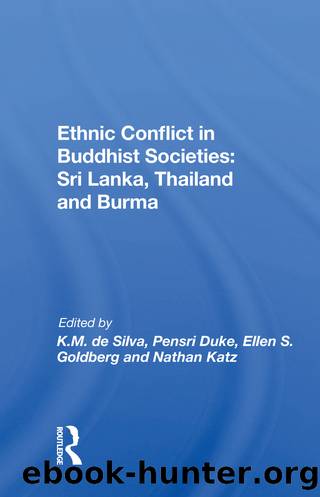
Ethnic Conflict in Buddhist Societies: Sri Lanka, Thailand, Burma by Kinglsey M de Silva
Author:Kinglsey M de Silva [Silva, Kinglsey M de]
Language: eng
Format: epub
Tags: Social Science, Political Science, World, Asian, Regional Studies
ISBN: 9780429698620
Google: sgScDwAAQBAJ
Goodreads: 50935143
Publisher: Routledge
Published: 2019-04-15T00:00:00+00:00
Part III: Buddhist Institutions and Minorities
7 Buddhist Resurgence and Christian Privilege in Sri Lanka, C. 1940-1965*
K.N.O. Dharmadasa
Introduction
This chapter deals with a very significant phase in the long-drawn out encounter between Sri Lanka's once powerful Christian minority and its Buddhist majority. Earlier stages in this encounter are surveyed in an outstanding study by K. Malalgoda1 in which the reader will find an absorbing review of the eighteenth-century revival of Buddhism, and an account of the emergence of the present institutional structure of the Buddhist order, its various sects (called nikayas) and the failure to evolve a central organisation. The same author provides a trenchant analysis of the issues involved in the Buddhist-Christian confrontation of the last quarter of the nineteenth century2 in which we see the emergence of two new centres of Buddhist learning established in the 1870s, the two pirivenas of Vidyodaya (1873) and Vidyalankara (1875) in the suburbs of Colombo. In the present chapter the Vidyalankara pirivena and its alumni play a central role.
For the political background to the mid-twentieth century conflict between a resurgent Buddhism and Sri Lanka's Christian minority, the reader could turn to the works of W. Howard Wriggins3 and K.M. de Silva.4 It would be superfluous, therefore, to go in any great detail into this background in the present chapter, which will confine itself to a brief review of some of the issues that emerged at this time, to some of the key personalities involved in the principal controversies of the period, and to a look at an emerging shift in the balance of power within the Buddhist institutional framework. It will also demarcate some of the stages by which the erosion of Christian privileges was successfully achieved.
In Chapter 5 of the present volume, K.M. de Silva makes the important point that while the Christians, both Roman Catholic and Protestant, were less than a tenth of Sri Lanka's population, they were a privileged minority wielding considerable power and influence. By the 1940s this influence and power, if not yet the prestige of the Christian minority, were in decline.5 The Buddhist activists, bhikkhus as well as laymen, were unwilling to countenance the continuance of Christian privilege, and were intent on effecting a further substantial reduction of these, if not their total eradication. For this purpose they focused their attention on the schools which they regarded as the source of Christians' dominance of public life. The Roman Catholics were the dominant influence in the education system through their efficiently run network of schools. They were, at this stage, the principal defenders of the status quo in education which by the 1940s was under systematic attack by Buddhist activists.
Download
This site does not store any files on its server. We only index and link to content provided by other sites. Please contact the content providers to delete copyright contents if any and email us, we'll remove relevant links or contents immediately.
| Anthropology | Archaeology |
| Philosophy | Politics & Government |
| Social Sciences | Sociology |
| Women's Studies |
Cecilia; Or, Memoirs of an Heiress — Volume 1 by Fanny Burney(32561)
The Great Music City by Andrea Baker(32021)
Cecilia; Or, Memoirs of an Heiress — Volume 2 by Fanny Burney(31958)
Cecilia; Or, Memoirs of an Heiress — Volume 3 by Fanny Burney(31944)
We're Going to Need More Wine by Gabrielle Union(19050)
All the Missing Girls by Megan Miranda(16038)
Pimp by Iceberg Slim(14515)
For the Love of Europe by Rick Steves(14149)
Bombshells: Glamour Girls of a Lifetime by Sullivan Steve(14078)
Talking to Strangers by Malcolm Gladwell(13375)
Norse Mythology by Gaiman Neil(13372)
Fifty Shades Freed by E L James(13245)
Mindhunter: Inside the FBI's Elite Serial Crime Unit by John E. Douglas & Mark Olshaker(9346)
Crazy Rich Asians by Kevin Kwan(9295)
The Lost Art of Listening by Michael P. Nichols(7507)
Enlightenment Now: The Case for Reason, Science, Humanism, and Progress by Steven Pinker(7315)
The Four Agreements by Don Miguel Ruiz(6767)
Bad Blood by John Carreyrou(6625)
Weapons of Math Destruction by Cathy O'Neil(6283)
